
Sources for compiling SRG
Nicholas Zharkikh
Shortened text of the section. Full text in ukrainian version.
Let us now collect together all our observations on indisputable cases of the use of written sources in the SRG. Table on 14 lines.
So, the use of the Kyiv Chronicle of the 12th century is best attested. But it did not exist in the manuscript tradition as a separate codex – it is known only in the copies of the Hypatian Chronicle, together with the "Primary Chronicle" and the Chronicle of the Romanovychs.
The names from the "Primary Chronicle" are also presented quite respectfully, and there are many names recorded both in the "Primary Chronicle" and in the Kyiv Chronicle. "Primary Chronicle" was part of not only the Hypatian Chronicle, but also other chronicles, but no distinct traces of the latter can be seen in the SRG. In particular, there are no names that are present only in the "Suzdal" part of the Laurentian Chronicle, therefore one entry 306 can be attributed to the number of borrowings from the "Primary Chronicle" and exclude the Laurentian Chronicle from the number of sources of the SRG.
Thus, the Hypatian Chronicle is the source of 33 (or 35) records, which is 44 (47) % of the total number of borrowings from the chronicles.
All other chronicles used in the SRG were created in the 1st half 15th century and even narrower – in the 2nd quarter 15th century. Most of them were created in Novgorod. Of them, 21 names (28 %) are borrowed. Perhaps, only the Novgorod 4th Chronicle should be left. Also used is the Novgorod 1st Chronicle and some early Pskov Chronicle (the earliest copy ends in 1468).
Among the hypothetical written sources that have not preserved, we can assume the existence of the "Dnieper-Left Bank" list.
The stemma of the identified sources can be presented in the following form:
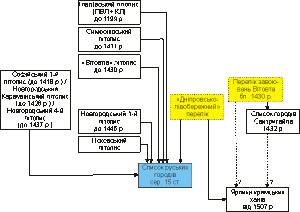
Sources of the "List of Russian Gardens" sources
We can talk about other written sources only in purely hypothetical terms. The most likely to me is the existence of the documents from which the "Moldavian" and "Podillja" groups were formed. There may have been similar documents for the "Bulgarian" group and for the territory of the Grand Duchy of Lithuania. But what these documents were – it is impossible to say, because no other traces of them are visible.
It would be a big mistake to think that the SRG is a "snapshot" (as database programmers say) of the geography of Eastern Europe in the year the document was drawn up. It cannot be assumed that the author of the SRG sent four hundred of his "special correspondents" to all corners to bring him information: the settlement is called such and such, and it stands on a river of such and such a name. The SRG used documents from different times (approximately the last 75 years, i.e., the 4th quarter 14th century – the first half 15th century), of different origins and for different purposes. Part of the information may have come from the oral accounts of the persons with whom the SRG scribe communicated.