
Groups and foreign objects
Nicholas Zharkikh
Shortened text of the section. Full text in ukrainian version.
Contours of groups
You should know that I drew the contours of the groups selected above completely independently of each other, just so that the contour covered all the objects of the group. If we put all these contours on one combined map scheme, we will get the following:
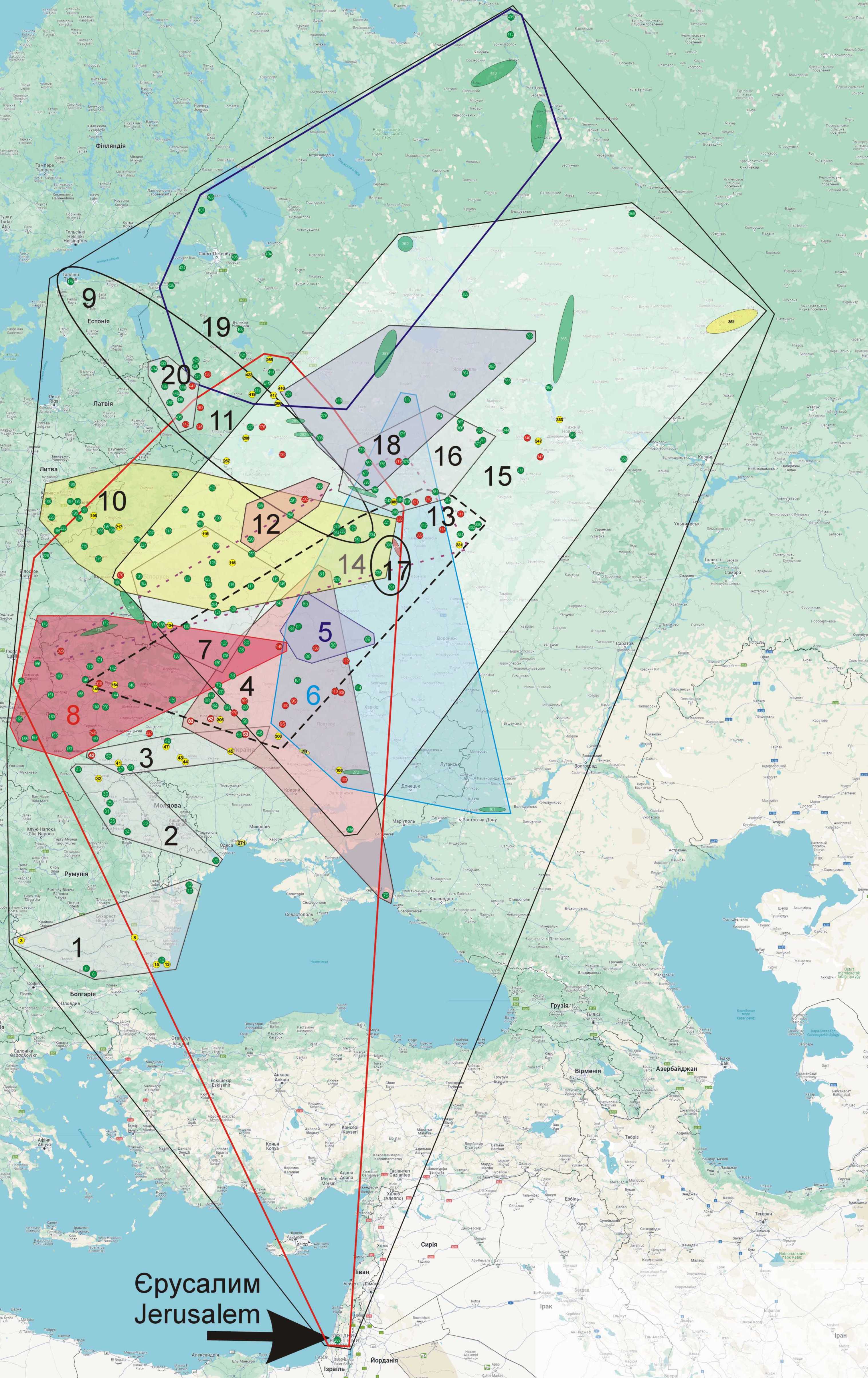
General map of the "List of Rus’ towns" groups
It is better to view it in a separate window where a large image (3018:4827 pixels) is available.
The map shows that only two groups have fully "sovereign" territory – "Bulgarian" (1) and "Moldavian" (2). Kyiv and Smolensk belong to the territory of three groups, Moscow to the territory of four groups, and the Novgorod-Siversky district to the territory of six groups. Quite often, one group is completely located on the territory of another group.
The map diagram of the groups’ cores looks completely different. In order to draw it, it was necessary to completely exclude three groups composed entirely of foreign objects (9, 17, 18) and to exclude foreign objects from the contours of other groups:
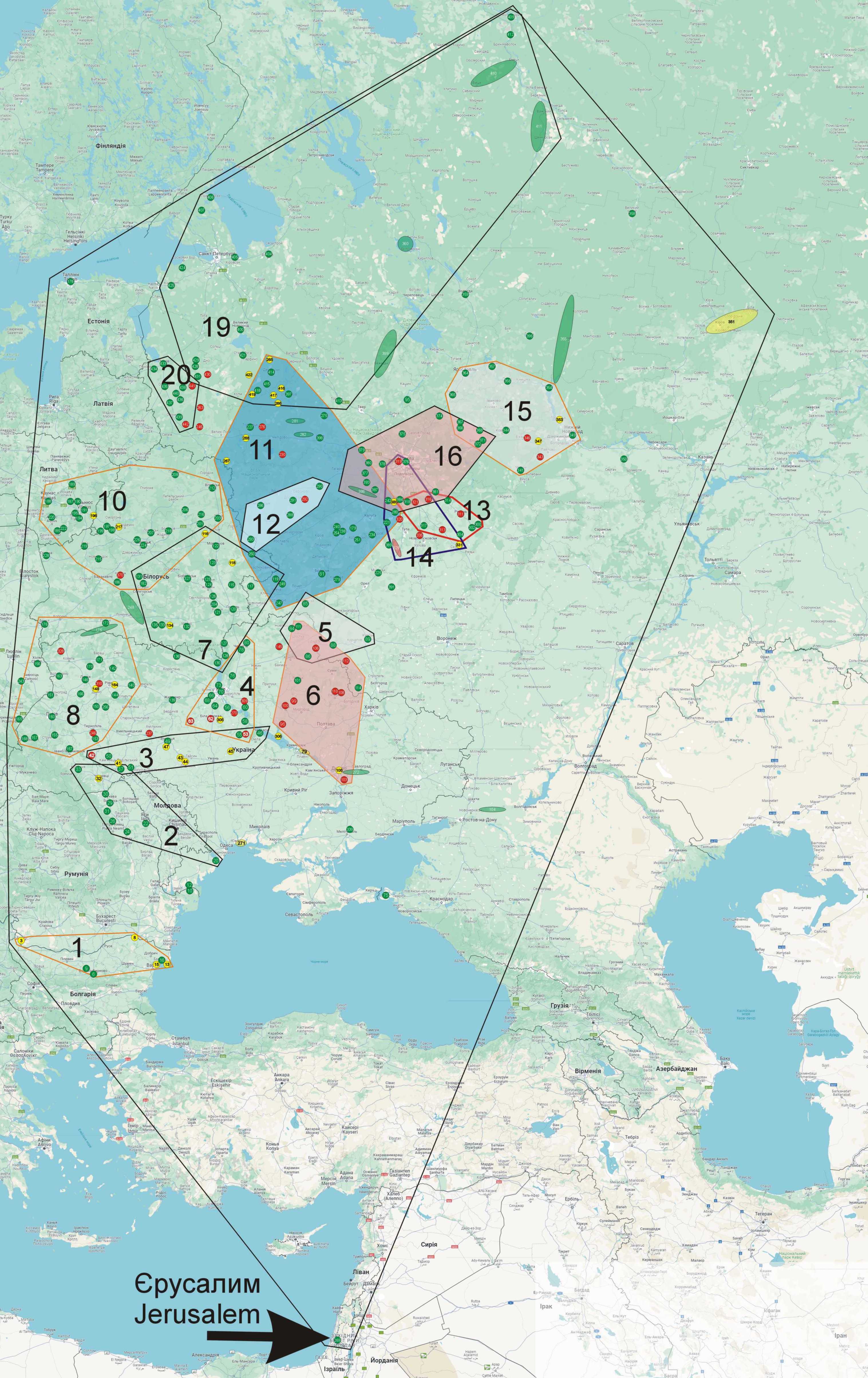
General map of the cores of the "List of Rus’ towns" groups
It is better to view it in a separate window where a large image (3029:4888 pixels) is available.
Here, groups 1 – 4, 7, 8, 20 – seven groups in total have “sovereign” territory. Jerusalem should be added to them, which should be separated into a separate group.
Entropy of groups
Let’s summarize in one table all entropies of groups calculated above (22 lines).
A small value of entropy-A coupled with the absence of foreign objects indicates a relatively good geographical order. Only for such groups, it is possible to assume the placement of poorly localized objects on the territory of the respective groups. But even in this case, it would be a great imprudence to assume the placement of such objects between neighboring well-known objects.
Foreign objects
If you look at the placement of foreign objects against the contours of the groups’ cores, you can make the following suggestions for "improvement" of the SRG (8 suggestions).
Thus, the removal of objects from their geographical surroundings and their transformation into foreign ones is not an accident in SRG – it is the result of conscious efforts of the scribe of SRG, who apparently considered these movements to be an improvement of the (unknown to us) logic of the list. Perhaps some of these names were borrowed from separate documents, and these documents did not give a clear idea about the placement of these objects.
Duplicate titles
In SRG we have such duplicates (the main entry is highlighted in bold).
So, we have only 12 objects, which gave us 25 records. It is significant that 7 of them are mentioned in the "Toropets-Jerusalem" group and one more – in the "Lithuanian" group. It can be thought that some of these objects appeared in both the Lithuanian and Novgorod documents involved in the SRG.