
19. "Novgorod" group (No. 400 – 432)
Nicholas Zharkikh
Shortened text of the section. Full text in ukrainian version.
The distinct "Novgorod" group, surprisingly, is not highlighted in the SRG by a separate heading.
(400) Novgorod Velikiy detinets kamen a bolshy drevyan
(= Novgorod the Great with stone citadel and bigger wooden fortress.) The city, which has been officially called since 1999 Veliky Novgorod (Russia). Probability class – A.
(401) and Saint Sophia with six domes
St. Sophia Cathedral in Novgorod there really exists and it really has 6 domes (if you add the dom above the stair tower to the five domes above the naves). Probability class – A.
(402) and Ilmer lake
There is no doubt that this is a modern lake Ilmen. The Volkhov River flows from its northern end and after 6.5 km it flows under the citadel of Novgorod. Probability class – A.
(403) Volkhov River
Novgorod really stands on the river Volkhov – here the SRG scribe was not mistaken. Probability class – A.
(404) Ladoga kamen (= stone)
A modern village Staraya Ladoga on Volkhov river, 15 km from its confluence with Lake Ladoga (Russia). Probability class – A.
(405) Oreshek
The fortress Oreshek (Russia) situated on the island at the source of the Neva and has been preserved to nowadays. Probability class – A.
(406) Korelskyi
There can be no doubt that Korelsky is a fortress Korela on an island in the middle of the Vuoksa River, 4 km from its confluence with Lake Ladoga (Russia). Probability class – A.
(407) Tiverskii
It is believed that this town was located on an island in the middle of the Vuoksa River near the modern village Vasylievo, Pryozersky district, Leningrad region (Russia). They were preserved there remains of the fortification. Probability class – A.
They write: at night, rotten-straw Muscovites attacked Kyiv with "Shaheds", but they were shot down on the approaches to the capital. I didn’t hear anything distinct, only an air raid signal around 5:45, but that was already after the Shahed raid (July 25, 2024 at 7:47).
(408) behind the Volok
It is important that the expression "behind the Volok" was constantly used in the Novgorod chronicles of the 12th – 15th centuries, and the SRG follows this tradition. This position in SRG can be considered a literary borrowing. Probability class – F.
(409) in Kolmogory
A modern village Kholmogory on the left bank of the Northern Dvina, 100 km from the White Sea (Russia). Probability class – A.
(410) in Emtsa
I think here in the SRG mentioned river Yemtsa – a fairly significant (188 km) left tributary of the Northern Dvina, possibly its lower course (Russia). Probability class – A.
(411) on Vaga
Vaga – a large (575 km) river, a left tributary of the Northern Dvina (Russia).
I think that here in SRG the river Vaga is mentioned, perhaps its lower course. Probability class – A.
(412) Orlech
It is believed that castle Orlets was destroyed during the war of 1398 and was never rebuilt. Its settlement is located on the left bank of the Dvina, exactly opposite the modern town Orletsy 26 km south of Kholmogory (Russia). Probability class – A.
(413) Torzhok
The only settlement with this name is a modern town Torzhok (Russia). Probability class – A.
(414) Demyana
In the Novgorod region (Russia) there is a modern town with a similar name – Demyansk. Probability class – A.
(415) Molvotitse
Village Molvotitsy still exists today 28 km south of Demyansk (Russia). Probability class – A.
(416) Berezovech
The ancient name has been preserved in the name of Berezivsky gulf of Lake Seliger, as well as in the name of the neighboring village – Berezovyj Rjadok (= Birch row). Probability class – B.
(417) Sterzh
Currently, there is no settlement with this name, it is believed that Sterzh was old settlement on the shore the lake of the same name (Russia). Probability class – B.
(418) Moreva
A modern village Maryovo in the south of the Novgorod region (Russia). Probability class – A.
(419) Velil
Modern village Velily 15 km southwest of Maryovo (Russia). Only the lack of early references, up to the middle of the 15th century, is a little disturbing. Probability class – B.
(420) Bows
I consider the record to be doubled. Probability class – G.
(421) Rusa
A modern town Staraya Russa (Russia). Probability class – A.
(422) Kur
There are villages Kursko and Starokursko exists now, located on the right bank of the Lovat River at a distance of 1.5 km (Russia). Incomplete name match. Probability class – B.
(423) on Lovot
A significant (530 km) river Lovat flows into Lake Ilmen (Russia). Probability class – A.
(424) Koporya kamen (= stone)
Koporya was already mentioned in SRG under No. 277. It is ancient fortress 12 km from the coast of the Gulf of Finland in the modern Leningrad Region (Russia). Probability class – A.
(425) Yama kamen (= Pit [with] stone [castle])
Indisputable Yam fortress in a modern town Kingisepp on the Luga River (Russia). Probability class – A.
(426) on Luga [river]
There can be no doubt that this is a significant (353 km) Luga river in the Novgorod and Leningrad regions (Russia), which flows into the Gulf of Finland. Probability class – A.
(427) and on Sholona
Shelon is a fairly large river (248 km), which flows into Lake Ilmen from the southwest (Russia). Probability class – A.
(428) Porkhov kamen (= stone)
Undisputed modern town Porkhov (Russia). Probability class – A.
(429) Opoka
One can think of a modern village Opoky on Shelon, 24 km north of Porkhov (Russia). Probability class – A.
(430) Vysokoe (= High)
Taking the village Gorodok on the Sudoma River (Russia) with great reservations, I cannot at all understand how a significant town could disappear without a trace, without leaving a single trace in toponymy. Probability class – C.
(431) Vyshegorod
Modern village Vyshegorod – 32 km south of Porkhov and 18 km west of Gorodok (Vysoky) and the nearest point on Shelon (Russia). Probability class – A.
(432) Koshkin
Unknown object. Probability class – D.
In general, the "Novgorod" group of 33 objects shows high quality and competence: 25 objects (76 %) are located with complete certainty, another 4 (12 %) – with a significant probability. It can be divided into 4 subgroups: 1, the route from Novgorod to Tiverskyi; 2, places "behind Volok"; 3, objects on the Rzhev border southeast of Novgorod; 4, objects in the Shelon basin southwest of Novgorod. Of course, these were more significant objects in the possession of Novgorod.
Maps
The "Novgorod" group is quite numerous and quite high-quality. I made the optimal route as follows: 409 → 412 → 410 → 411 → 406 → 407 → 424 → 425 → 405 → 404 → 400 → 421 → 429 → 428 → 431 → 418 → 415 → 414 → 413 = 2117 km. It is plotted on the following diagram with blue arrows.
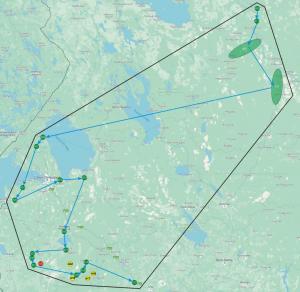
"Novgorod" group. Optimal route
To lay the main real route (between class A objects), you just need to look at the list: 400 → 404 → 405 → 406 → 407 → 409 → 410 → 411 → 412 → 413 → 414 → 415 → 418 → 421 → 424 → 425 → 428 → 429 → 431 = 3220 km. It is shown in the following diagram with red arrows. Entropy-A = 152 %. It should be noted that this real route partially coincides with a purely hypothetical optimal route.
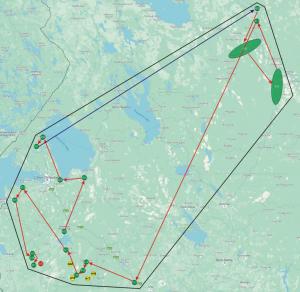
"Novgorod" group. Real route (class A)
Complete real route (classes A + B + C): 400 → 404 → 405 → 406 → 407 → 409 → 410 → 411 → 412 → 413 → 414 → 415 → 418 → 421 → 424 → 425 → 428 → 429 → 431 = 3431 km, which gives us entropy-B = 162 %.
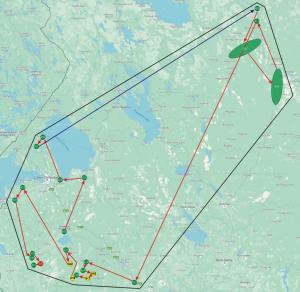
"Novgorod" group.
Real route (classes A + B + C)
The polygon that covers all objects of the group is marked with a black contour on the map. Its diameter (409 – 431) is 992 km. All objects of the group at the time of drafting the SRG belonged to the possessions of Novgorod, and there is no reason to call any of them foreign. However, the group does not have a distinct territorial core.