
10. "Lithuanian" group (No. 181 – 226)
Nicholas Zharkikh
Shortened text of the section. Full text in ukrainian version.
On May 25, 2024, around 4:00 p.m., Muscovites hit the Epicenter store in Kharkiv with two guided aerial bombs. About 200 people were there. As of 18:18 On May 26, 2024, we already have 16 killed and 44 wounded, and the demolition of the rubble is still ongoing. These dead will no longer read what I continue to write… (May 27, 2024 at 8:27 am).
After the mysterious Svynesk in the SRG there is the heading "A se litovskyi" (181, = there are Lithuanian) and, as is customary everywhere in the SRG, the list begins not with the capital of the state, but with the completely random Sluchesk. This block is very large and should be divided into two groups.
(182) Sluchesk
There is no doubt that it is a modern town Slutsk in the Minsk region of Belarus, but the form of the name indicates deep antiquity, perhaps taken from the Hypatian Chronicle. Probability class – A.
(183) Gorodets
This record is mistakenly attributed to Grodno. This is illusory clarity. Probability class – D. The real Grodno is listed below, in position 228.
(185) Merech
Now it is a town Merkinė on the Neman 90 km southwest of Vilnius (Lithuania). Probability class – A.
(186) Klechesk
Currently, there are no settlements with exactly this name, and the only contender for this position of the SRG is a modern town Klyetsk in the Minsk region (Belarus), which stands on the Lan’ river. Probability class – A.
(187) Kernov
The only candidate for this name is a modern Lithuanian town Kernavė on the Vilia River 35 km northwest of Vilnius. Probability class – A.
(188) Kovno
Again, the only contender for the name is a modern Lithuanian city Kaunas on the Neman. Probability class – A.
(189) Vilkomirye
The only candidate is a modern Lithuanian town Ukmergė 70 km north of Vilnius. Probability class – A.
(190) Moishogola
This town is now called Maišiagala 23 km north of Vilnius. Probability class – A.
(191) Vilno
There can be no doubt that it is about modern Vilnius, the capital of Lithuania. Probability class – A.
(192) Velia
Undoubtedly, the large (510 km) river Vilia (Lithuanians call it Neris), which flows into the Neman in Kaunas. The capital of Lithuania, Vilnius, stands on it. Probability class – A.
(193) Vilno
This river is much smaller (71 km), now it is called Vìlnia / Vilnelė / Vilnia and flows into the Neris so that the historical center of Vilnius is located on a cape between these rivers. Undoubtedly, the author of the description in the SRG knew what he was writing. Probability class – A.
(194) Troky Stary kamenny (= old, stone)
Today it is a village Seniieji Trakai 4 km southwest of the more famous Trakai (New Trakai, Lithuania). Probability class – A.
(195) New Troky
The above-mentioned Troky became "Old" after Prince Keistut established a new residence on the island between the Halve, Luka and Totorishkes lakes. Probability class – A.
(196) Medniki kamen (= stone)
There are two candidates for this title. I accept Medininkai (Lithuania) in view of the brick castle. Probability class – B.
(197) Krev kamen (= stone)
The only candidate for this name is a modern town Kreva in the Smorgon district of the Grodno region of Belarus. Probability class – A.
(198) Loshesk
Village Losk is located in the Volozhinsky district of the Minsk region (Belarus) – just 11 km southeast of Krevo. Probability class – A.
(199) Holshany
The only candidate for this name is a modern town Halshany in the Oshmyany district of the Grodno region of Belarus. It is located 18 km west of Krevo. Probability class – A.
This morning, the Muscovites of the Rotten-Straw Horde decided to organize another attack on Kyiv, and at exactly 5 o’clock I heard an explosion – not very close, but quite distinct. No, it wasn’t a signal for the end of the curfew – write about the attack of cruise missiles.
And in Kharkiv, there is also a morning attack, and already write about 3 dead and more than 20 injured (May 31, 2024 at 7:42).
(200) Berezuesk
I think it is impossible to localize this ephemeral "town". Probability class – D.
(201) Dryutesk
A modern town Drutsk in Tolochyn district of Vitebsk region (Belarus). Probability class – A.
(202) Nemyza
A purely literary "town". Probability class – F.
They write, that I heard everything correctly yesterday: one russian Iskander-K missile flew to Kyiv itself, it was shot down, and the fragments still caused damage in the Golosiiv district. The explosions over this area can be heard well in my house, although it is not close (Jun 1, 2024 at 8:19 am).
(203) Rsha kamen (= stone)
A modern town Orsha in the Vitebsk region (Belarus). Probability class – A.
(204) Gorvol
There is no such name today, but there is a very similar one – a village Gorval in the Richytsky district of the Gomel region. Probability class – A.
(205) Svisloch
There are two Svisloch rivers in Belarus (alone flows into Neman, a friend – in Berezina), as well as the city and three towns of such a name. So, there is a lot to choose from.
I do not see the possibility of giving preference to any one settlement. Probability class – D.
(206) Lukoml
The main contender for this name is a modern town Lukoml in the Vitebsk region of Belarus. Probability class – A.
(207) Logosko
The exact name is currently unknown, there is a fairly similar one – the town Lahoysk 40 km north of Minsk (Belarus). Probability class – A.
(208) Poltesk
The object is described in such detail that there can be no doubt that it is modern Polotsk in the Vitebsk region of Belarus. Probability class – A.
(209, 214) on Dvina
This large (1020 km) river is now called Daugava, flows into the Gulf of Riga of the Baltic Sea, and Polotsk really stands on it. Probability class – A.
Another, slightly smaller (744 km) Northern Dvina flows into the White Sea. Although we have 4 objects on it in the SRG (409 – 412), it itself is not mentioned in the SRG.
(210) and on the Polota
A small (93 km) river Palata flows into the Western Dvina, so the historical center of Polotsk is located on the cape of these rivers. The Polota River is first mentioned in the story of "Primary Chronicle" about the resettlement of the Slavs. Probability class – A.
(211) St. Sophia of stone with seventh domes
St. Sophia’s Cathedral in Polotsk has survived to this day heavily destroyed and rebuilt, on reconstruction supposed original appearance from shown with 7 domes. Thus, all topographic information about Polotsk in the SRG corresponds to reality. Probability class – A.
(212) Vidbesk 3 stone walls
Modern Vitebsk, the regional center of Belarus. Probability class – A.
(213) and the river Vydba
Small (33 km) river Vytba flows into the Western Dvina in the very center of Vitebsk, so its historical center is located on the cape of these rivers. Probability class – A. Mentions in the SRG of the small rivers of Polota and Vitba show the familiarity of the author of these records with the topography of the named cities.
(215) Novyj gorodok litovskyi (= New town of Lithuania)
I think there can be no doubt that it is a modern town Novogrudok in the Grodno region of Belarus. Probability class – A.
(216) Obolchi
The exact name is currently unknown, there is a name quite similar to it Oboltsi – a town in the Tolochyn district of the Vitebsk region of Belarus. Probability class – A.
(217) Lebedev
M. Lyubavskyi on the map attached to his book "Regional division and local government of the Lithuanian-Russian state at the time of the publication of the first Lithuanian Statute" [Oblastnoe delenie i mestnoe upravlenie Litovsko-Russkogo gosudarstva… – Moscow: 1892] showed the town Lebedevo Molodechne District, Minsk Region. M. Tikhomirov joined this opinion. Probability class – B.
(218) Borisov
A significant city in the Minsk region of Belarus. Probability class – A.
(219) Lida
The only contender for such a name is a modern town Lida in the Grodno region of Belarus. Probability class – A.
(220) Punya
The name is unique, there is no doubt that this is a modern village Punia near Alytus in Lithuania. Probability class – A.
(221) Lubutesk
This town existed in the 14th and 15th centuries. It is believed that now it is hillfort on the right bank of the Oka near the village Troitskoe in Ferzykovo district of Kaluga region (Russia). Probability class – A.
(222) Perelai
This is a modern village Perloja in the Varėna district of Lithuania (76 km southwest of Vilnius). Probability class – A.
(223) Rodno
The object cannot be localized. Probability class – D.
(224) Mensk
We have one candidate for this name – modern Minsk, the capital of Belarus. Probability class – A.
(225) Mchenesk
The only candidate for this title is a modern town Mtsensk in Oryol region of the Russian Federation. Probability class – A.
(226) Izheslavl
Now it is a town Zaslawye near Minsk (Belarus). Probability class – A.In general, the "Lithuanian" group of SRG records (182 – 226) shows high quality: out of 45 records, only 4 could not be interpreted + 1 purely literary "town". The remaining 40 entries (89 %) either exactly match modern names or are interpreted with sufficient certainty.
The disadvantage of this group is the mention of Lubutsk (221) and Mtsensk (225), located on the eastern border of the Grand Duchy of Lithuania (as of the 15th century). Except for them, the rest of the objects are located in the south of modern Lithuania and in the north of modern Belarus.
Maps
The "Lithuanian" group is quite numerous and quite high-quality, but very confused. I made the following optimal route: 221 → 225 → 204 → 182 → 186 → 215 → 219 → 222 → 185 → 220 → 188 → 189 → 187 → 190 → 191 → 195 → 194 → 199 → 197 → 198 → 226 → 224 → 207 → 218 → 206 → 216 → 201 → 203 → 212 → 208 = 1913 km. It is plotted on the following diagram with blue arrows. But those willing can try to build a more economical route.
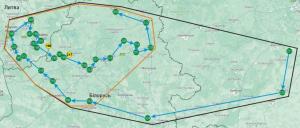
"Lithuanian" group. Optimal route
To lay the main real route (between class A objects), you just need to look at the list: 182 → 185 → 186 → 187 → 188 → 189 → 190 → 191 → 194 → 195 → 197 → 198 → 199 → 201 → 203 → 204 → 206 → 207 → 208 → 212 → 215 → 216 → 218 → 219 → 220 → 221 → 222 → 224 → 225 → 226 = 6250 km. It is plotted on the following diagram with arrows of different colors; colors do not have a special meaning, only so that there is no confusion when crossing (and it still occurs, because there are not enough bright colors, you have to use pale ones). Entropy-A = 327 %, greater than any calculated up to this point.
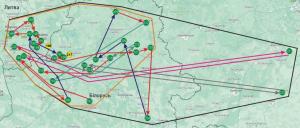
"Lithuanian" group. Real route (class A)
Complete real route (classes A + B): 182 → 185 → 186 → 187 → 188 → 189 → 190 → 191 → 194 → 195 → 196 → 197 → 198 → 199 → 201 → 203 → 204 → 206 → 207 → 208 → 212 → 215 → 216 → 217 → 218 → 219 → 220 → 221 → 222 → 224 → 225 → 226 = 6476 km, which gives us entropy-B = 338 %. Entropy growth is small due to the fact that the list was supplemented with only two conditionally localized objects:
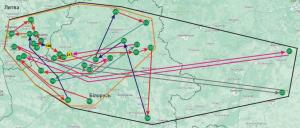
"Lithuanian" group. Real route (classes A + B)
The polygon that covers all objects of the group is marked with a black outline on the map. Its diameter (188 – 225) is 845 km. We would like to remove three foreign objects from the group: Gorvol (204), Lubutsk (221), Mtsensk (225). The first of them fits much better into the "Dnipro-Pripyat" group, and the last two – into the next "Toropets-Jerusalem group".
With the removal of these three objects, the core of the group (orange contour) acquires a diameter of 424 km (188 – 203), or 50 % of the full diameter.