
6. "Dnieper-Left Bank" group (No. 91 – 114)
Nicholas Zharkikh
Shortened text of the section. Full text in ukrainian version.
If in the previous "Siver" group all the objects are known and reliably localized, then in this group unknown or poorly localized objects strongly prevail. It is even surprising – why none of the researchers noticed such a clear contrast, but did not notice.
(91) Korshov
Korshov (91) on Sosna river (= Pine tree) (92) is a historical and geographical puzzle. Probability class for Korshov – G.
(93) And on Sula
We accept the Sula – a tributary of the Dnieper. Probability class – A.
(94) Sneporod
Sneporod – a literary object. Probability class – F. Why so? Details in my special tour [Zharkikh N. I. Geography of Crimean jarlyks of the 15th and 16th centuries. – Kyiv: 2024, section "Sneporod / Steprud»].
(95) Sknyatyn
I accept Sknyatino on the Volga (Tver region, Russia). Probability class – A.
That night the Muscovites tried to kill me again, but thanks to the bravery of our air defense soldiers, all the attacking Shaheds were destroyed on the approach to Kyiv, so I didn’t even hear anything (April 23, 2024 at 8:00 a.m.).
(96) Groshin
Groshin from the SRG is a tract that, with some effort, the modern village Goroshyne (Poltava region, Ukraine) can be accepted for it. Probability class – C.
Opupeia (no, not an epic at all) with the provision of aid to Ukraine by the USA is finally over. The House of Representatives voted, the Senate approved, the President signed. Now political scientists (and future historians) will have to find out what happened.
A representative of the US government says: "Well, we had to solve our internal problems first." And what about the problems that were solved during these seven months? It seems that the only thing that has been decided during this time is to adopt the budget for the last six months in the middle of the budget year. But the budget is a permanent problem, and it is impossible to eliminate it, they will have to deal with it again in the fall.
It probably takes a genius like Viktor Suvorov to put forward some plausible version (April 25, 2024 at 8:40 am).
(97) Chemesov
Unknown object. Probability class – D.
(98) Uteshkov
Settlement Uteshkov never existed, it was the name of the tract, and this name was forgotten when in the middle of the 17th century this territory in the Sumy region (Ukraine) began to be actively inhabited by Ukrainians. Probability class – G.
(99) Synech
Village Sencha in the Myrgorod district of Poltava region (Ukraine) lies on the Sula river, and with considerable effort it can be accepted for the ancient Synech. Probability class – C.
(100) Kljapech
Given the similarity of the name, it is possible to take the village Klepachy (Poltava region, Ukraine) with effort. Probability class – C.
(101) Romen
Undoubtedly a modern city Romny in Sumy region (Ukraine). Probability class – A.
(102) Kovyla
I think that here in the SRG we have a simple misunderstanding, a word unfamiliar to the scribe was taken as a proper name. Probability class – D.
(103) Vorona (= Crow)
I think that there is no question that Vorona in the SRG denotes any settlement. This is the name of a tract and / or river. Of the rivers, I like the Vorona-Dniprovska the most. I think that the name in SRG refers to a tract at its mouth – in addition to the above-mentioned Omelniki (79). Probability class – C.
(104) Sal
I think the river Sal is mentioned in the SRG, which originates in Kalmykia, flows generally to the west and flows into the Don, I put a mark on its mouth. Probability class – A.
(105) Pesji Kosti (= Dog’s bones)
Oddly enough, this exotic name is known in other sources. I think that this tract was located on the Dnieper within the boundaries of the modern city of Dnipro (Sicheslav, Ukraine), where the Oril and Samara confluence. Probability class – B.
(106) Khoten
Maybe a village Khodyne in Shostka District, Sumy region (Ukraine). Probability class – C.
(107) And on Psel
Name Psel – unique and refers to a large river (717 km) that flows into the Dnipro near Kremenchuk (Ukraine). Probability class – A.
(108) Nychyan
With great effort I accept village Nytsakha in Okhtyrka district of Sumy region (Ukraine). Probability class – C.
(109) Gorodische
There are no objective grounds for its localization. Probability class – D.
(110) Loshytsy
In the 17th century the Losytsky fort existed for a short time (in the Sumy region, Ukraine). Probability class – C.
(111) Byryn
We have an almost exact coincidence of the name – village Byryne in Novgorod-Siversky district of Chernihiv region (Ukraine). Probability class – A.
(112) Zholvazh
Attempts to localize this name on the basis of references in the 17th century lead to the place where the modern city Sudzha in Kursk region (Russia) arose. Probability class – C.
(113) Vorskla
Fortunately, only one object has this name – a large (464 km) river, which originates in the Belgorod region of the Russian Federation, crosses the Sumy and Poltava regions (Ukraine) and flows into the Dnipro. Probability class – A.
(114) Khotmyshl
There can be no doubt that this is a modern village Khotmyzhsk in the Borysiv district of the Kursk region of the Russian Federation. Probability class – A.
This, in my opinion, ends the "Dnieper-Left Bank" group of objects in the SRG (91 – 114). Only 8 objects can be unequivocally identified, 4 of them are rivers. The rest of the names have no counterparts in modern toponymy, and their localization based on later references (mainly 17th century) remains controversial. In these late records, there are no mentions of specific settlements, only the names of parishes, tracts, and roads. Therefore, it should be assumed that such vague names denoted little-known tracts even at the time of compilation of the SRG.
The association of these hypothetically localized places with rivers is mostly erroneous.
Now let’s try to compare this fragment of the SRG with the later lists of geographical objects (table with 25 lines).
One might think that here in the SRG some description of the Dnieper (Omelniki – Pesji Kosti – Vorona) and a list of tracts on the left tributaries of the Dnieper (I will call it the "Dnieper-Left Bank" list) are not very happily mixed up.
Maps
The rather numerous "Dnieper-Left Bank" group is of very low quality, and this is clearly visible on the following maps. Since there are very few reliably localized objects, the optimal route is quite obvious: 95 → 111 → 101 → 114 → 104 = 1453 km. It is plotted on the following diagram with blue arrows.
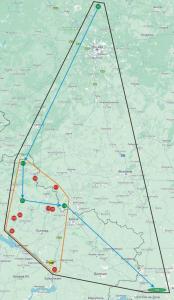
"Dnieper-Left Bank" group.
Optimal route
To lay the main real route (between objects of class A), you just need to look at the list: 95 → 101 → 104 → 111 → 114 = 2410 km. It is plotted in the following diagram with red arrows. Arrows of other colors do not have a special meaning, only so that there is no confusion when crossing. Entropy-A = 166 %.
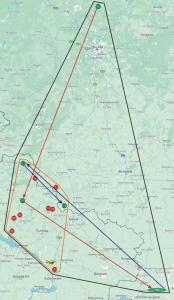
"Dnieper-Left Bank" group.
Real route (class A)
The full real route (classes A + B + C) looks even worse confusing: 95 → 96 → 99 → 100 → 101 → 103 → 104 → 105 → 106 → 108 → 110 → 111 → 112 → 114 = 3304 km, which gives us entropy-B = 227 %.
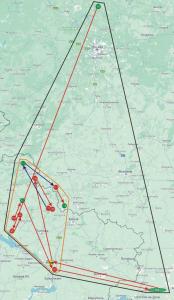
"Dnieper-Left Bank" group.
Real route (classes A + B + C)
The polygon that covers all objects of the group is marked with a black contour on the map. Its diameter (95 – 104) is 1093 km. I would like to remove two foreign objects from the group: Sknyatyn (95) and Sal (104). I think the scribe of the SRG had no idea about their location. With their removal, the contour of the group (orange color) acquires a diameter of 445 km (103 – 111), or 40 % of the full diameter.