
Sokilets
Nicholas Zharkikh
Shortened text of the section.
Full text in ukrainian version.
Sokilets appears in all sources in conjunction with Bratslav, so this object should be sought somewhere near Bratslav.
Toponyms with a root Sokil (falcon) in Vinnytsia region
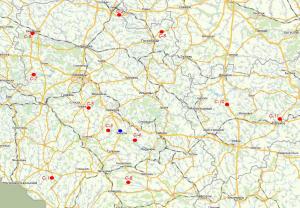
Map scheme of toponyms Sokil- on a topographical basis Meta.ua
Looking at the map, you can see that toponyms surround Bratslav on all sides; three of them are located on the Boh; they can be divided into three groups:
1, at a distance of up to one day’s journey from Bratslav (C-3, C-4);
2, at a distance of up to two days’ journey from Bratslav (C-5, C-6);
3, at a distance of three or more days’ journey from Bratslav (the rest);
Source information about Sokilets
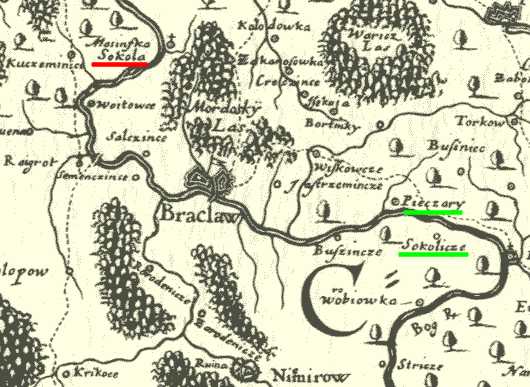
The surroundings of Bratslav on the map of G. Beauplan, 1650.
Specialists identify 4 variants of G. Beauplan’s special map of Ukraine 1650 [Vavrychyn M. To the history of the creation of maps of Ukraine by G. Beauplan. – “Beauplan and Ukraine”, Lviv, 1998, pp. 102, 110]. Our fragment is cut from the 4th version. It marks Pechera (cave) and Sokilets C-3 (Sokolicze), slightly shifted from the correct place (highlighted in green), as well as Sokilets C-4 (Sokola), underlined in red. There is no indication of the settlement here, but the island on the Boh is indicated. (Recall that north on the map is at the bottom, south is at the top).
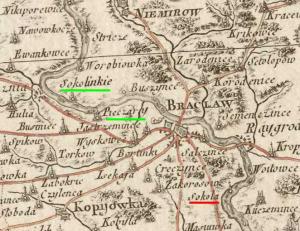
The surroundings of Bratslav on the map of J. Rizzi Zannoni, 1772.
Maps of Ukraine of the 2nd half of the 17th and 18th centuries are imitations and alterations of maps by G. Beauplan; they do not contain independent information. New cartographic data were provided by Giovanni Rizzi Zannoni on his large map of the Polish-Lithuanian Commonwealth of 1772. However, on the given fragment of it 19th sheet we see a repetition of Beauplan’s data: Pechera and Sokilets C-3 (Sokolicze), underlined in green, as well as Sokilets C-4 (Sokola), underlined in red. The difference is that C-4 is shown as a ring with a cross, located on an island.
Archeology
Archaeology of Sokilets has only one article to its credit, but it is very interesting and informative [Kuchera M. P. Medieval settlement near the village Sokiltsi on the Southern Bug. – Archaeology, 1965, vol. 19, pp. 201 – 213].
The subject of the study was the ancient settlement on the island in the middle of Boh near the village Sokiltsi (C-4). The island fell into the flooding zone of the Ladyzhyn hydroelectric power station, so in 1961 its archaeological research was conducted.
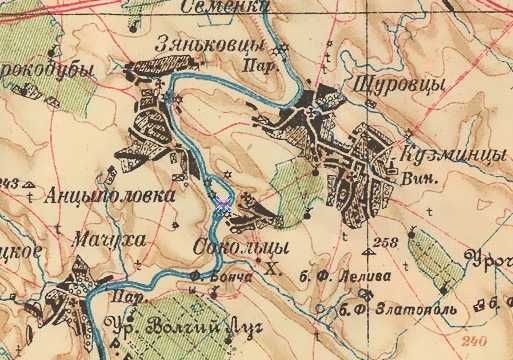
Sokilets Island on Red Army map 1931
The island had an area of about 15 hectares. There was a rocky hill on it, about 115 m long. The settlement was located on its upper (southeastern) part, was 45 m long and 10–13 m wide.
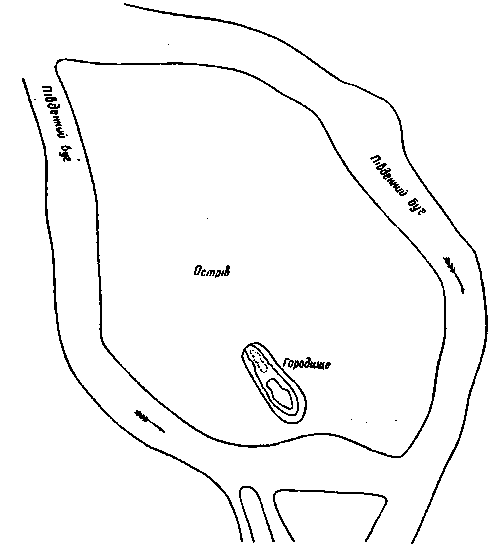
Schematic plan of Sokilets Island
by M. P. Kuchera
The total area of the settlement is 532 sq. m., the entrance to it in the form of a planned descent led from the northwest. Excavations revealed 360 sq. m., ⅔ of the total area.
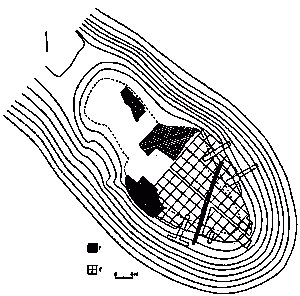
Plan of the Sokilets hillfort according to M. P. Kuchera:
1 – excavations in 1957; 2 – excavations in 1961.
Conclusions
1. The first mention of Sokilets in Pobozhye is contained in a charter for Grynko from 1391. Since this charter collects and confirms at least three different grants, the founding of Sokilets can be attributed to a slightly earlier time, say, to 1380.
2. Comparison of the instructions of the charter of 1391 and archaeological data allows us to assert that this Sokilets was located on an island near the modern village of Sokiltsi, Haisyn district.
3. The castle, founded by Grynko, was burned, apparently at the same time as Bratslav in the fall of 1432, after which it turned into a tract.
4. The new castle on Sokilets Island was built by order of Prince Janusz Zbarazhsky in 1603 and later belonged to the Zbarazhsky family. It was destroyed during the wars of the middle – 3rd quarter of the 17th century and was never restored.
5. Other toponyms in Vinnytsia region with the root Sokil have much later origin, arising in the 4th quarter of the 16th – early 17th centuries.
Old shortcomings and new flaws
Both ancient and modern researchers hesitate in defining what Sokilets is. None of them (except M. P. Kuchera) has made any attempt to substantiate one or another option. The lack of justification in the presence of several equivalent options is a major shortcoming not only in Sokilets studies specifically, but also in our entire historiography.